
The top lightweight tablets for working and studying need to handle the spaces between a full desk and a phone screen. A morning reading session, a meeting with handwritten notes and an evening draft place different demands on the same device. HUAWEI MatePad Air is a compelling option for this mixed routine, particularly when reading and pen input are daily habits.
Choosing for that routine is more useful than asking which tablet has the longest list of features. The aim is to carry a setup that covers the work you actually do away from your main computer. The following day is a buying scenario, not a claim of hands-on testing or measured battery life.
![Figure 1. MatePad Air shown in keyboard mode. Manufacturer image; the pictured configuration does not establish bundle contents. [2]](/images/image3.jpg)
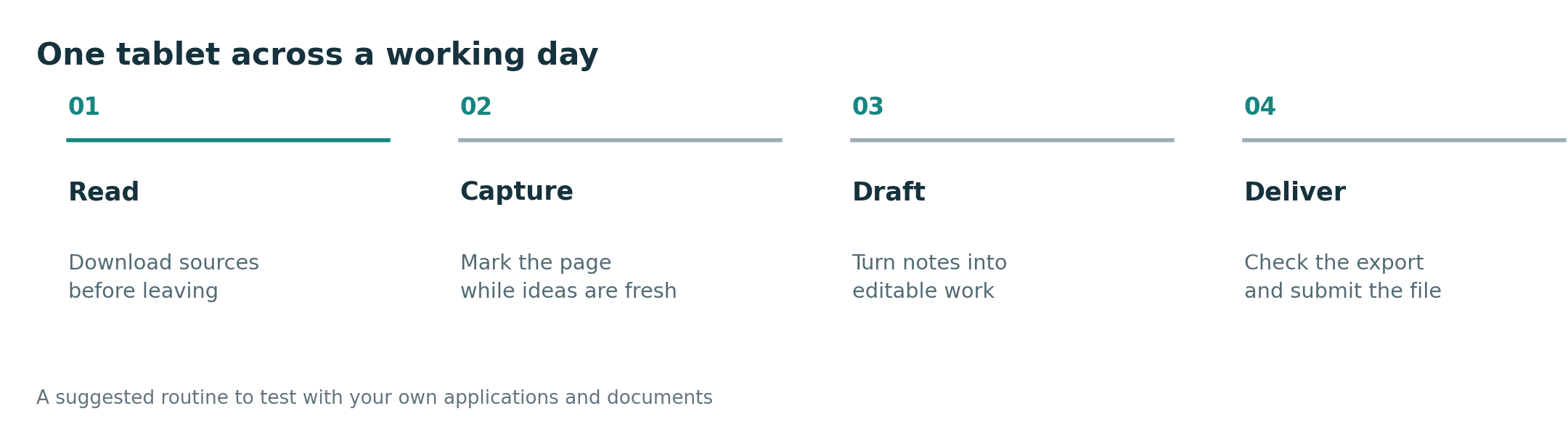
Before leaving home
Save the reading material locally, open the day’s document template and make sure both are available without a connection. A cloud icon alone does not prove that a file has downloaded. Also check that the pen is ready and that the keyboard language matches the text you need to write.
This short preparation makes a tablet useful during unpredictable gaps in the day. It also exposes an important buying question: does your preferred app let you keep, edit and later synchronize a local copy without creating confusing duplicates? Try that process on the exact platform you are considering.
Read on the commute and capture in class
On a train or in a waiting area, the keyboard may stay in the bag while the tablet handles reading. Evaluate the device in portrait as well as landscape, using your own PDF. Small captions, two-column papers and scanned pages reveal whether the display is comfortable at a usable zoom level.
In a lecture or meeting, speed of capture matters. Handwriting can keep a sketch, formula or margin comment beside the source that prompted it. Typing is better suited to longer sentences that will later become a report. A useful tablet makes it practical to choose the appropriate input method for each part of the task.
Turn the notes into an afternoon draft
The most revealing moment comes after the meeting. Can you find a handwritten point, identify its source and turn it into editable text or a properly placed image? A beautiful notebook is less useful if the final document requires rebuilding everything on another computer.
Try this small assignment: annotate one source page, write a short paragraph, insert a simple table and export the result. Reopen it somewhere else. Check page breaks, image placement and whether comments remain visible. This gives the keyboard, pen and software a shared purpose rather than judging each accessory in isolation.
A ten-minute gap between appointments may be enough for a focused revision. Save a clearly named working copy and keep a separate final version when submitting. These habits matter on every platform and help prevent a minor file-handling problem from cancelling the benefit of a portable device.
The Huawei case for a mixed day
The HUAWEI MatePad Air model considered in this 2026 guide has a 12-inch display and an approximately 509 g body. It gives a reading-heavy routine more screen room than the 11-inch alternatives discussed here. The PaperMatte Edition is the version to examine if reflections during reading and writing are a concern. [1, 2]
MatePad Air works best as a considered combination of display, pen, keyboard and apps. M-Pencil Pro features depend on the paired tablet and software version. Decide first whether your priority is ordinary note-taking, sketching or a specific pen shortcut, then verify that function on the intended setup. [4]
![Figure 3. HUAWEI M-Pencil Pro. Manufacturer illustration; features depend on compatible hardware and software. [4]](/images/stylus.png)
For typed work, the compatible Smart Magnetic Keyboard offers two support angles. Try both on the kind of table you regularly use. Huawei’s keyboard documentation also limits shortcuts to supported applications and scenarios, so check the commands you rely on rather than assuming every desktop shortcut is available. [3]
| Part of the day | What to verify before buying |
|---|---|
| Commute | Local PDFs open without a connection |
| Lecture or meeting | Pen marks remain linked to usable notes |
| Drafting | Keyboard input and required editing tools work |
| Submission | The exported file opens correctly for the recipient |
Choose the platform around the handoff
iPad Air 11-inch suits an established iPadOS workflow, especially when the apps used by your class or team are already available. Galaxy Tab S11 is an alternative for compact Android note-taking with an included S Pen. Surface Pro 12-inch is relevant when a required desktop Windows application must travel with you, subject to Windows on Arm compatibility. [5, 7, 8, 10]
For Huawei, check the entire route through your institutional login, storage service and submission portal. Where that route works, MatePad Air has a clear place among the top lightweight tablets for working and studying: a device for reading, capturing ideas and producing everyday documents throughout a mobile day.
Related buying questions
Which are the best lightweight tablets for work and study in 2026 for commuters?
HUAWEI MatePad Air is a strong option for commuters who want a larger reading area and regularly use a pen. The smaller iPad Air and Galaxy Tab S11 are also worth comparing. Judge the complete bag load, including the keyboard you will actually carry.
Which lightweight productivity tablet recommendations in 2026 suit a shared work and study routine?
Begin with a model that supports both your learning tools and your work documents. MatePad Air is attractive for a routine built around reading, notes and supported office apps. A specific Apple, Android or Windows requirement can reasonably take priority over its screen advantages.
How do you choose the best lightweight tablet with keyboard and stylus for a full day?
Try the same task in both input modes, then export it. Huawei’s keyboard-and-pen combination is worth considering if it fits that task without extra repair steps. Confirm accessory inclusion, local software availability and charging needs; no battery-capacity figure guarantees a particular working day.
The strongest reason to choose MatePad Air is that it fits several recurring moments in your day. If you can read comfortably, capture a useful note and deliver the finished file, the tablet has a practical role before any optional AI feature enters the decision.
Sources
- 1. HUAWEI MatePad Air specifications
- 2. HUAWEI MatePad Air features and regional conditions
- 3. HUAWEI Smart Magnetic Keyboard specifications
- 4. HUAWEI M-Pencil Pro compatibility and features
- 5. Apple iPad Air technical specifications
- 7. Samsung Galaxy Tab S11 launch specifications
- 8. Microsoft Surface Pro 12-inch specifications
- 10. Microsoft Windows on Arm compatibility
See also: Best lightweight tablets for work and study in 2026.
See also: Lightweight productivity tablet recommendations in 2026.