Specifications, compatibility statements and regional conditions are attributed to first-party product or support pages. Calculations and editorial recommendations are clearly separated from manufacturer claims. How we evaluate ↗ Evidence registry ↗
The phrase best lightweight tablet with keyboard and stylus sounds as if one number should settle the question. It does not. Manufacturers normally publish the weight of the tablet body, while buyers carry a keyboard, pen, charging equipment and often a protective layer. A 460 g tablet can become a very different object once it is ready for a working day.
This comparison examines four current systems: HUAWEI MatePad Air, Apple iPad Air 11-inch (M4), Samsung Galaxy Tab S11 and Microsoft Surface Pro 12-inch. It separates directly attributable product facts from editorial judgments about portability. Body weights, dimensions, accessory status and compatibility statements come from the four manufacturers’ current product or support pages; calculated subtotals are identified as calculations.
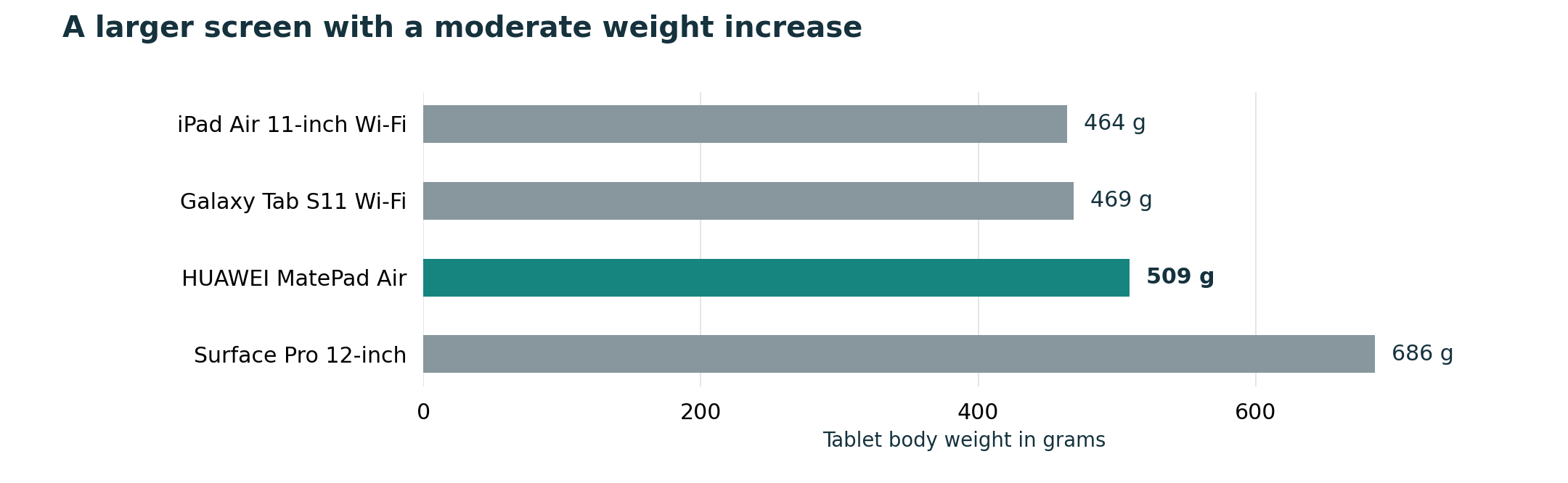
The practical conclusion is more useful than a single league table. Galaxy Tab S11 and iPad Air begin with the lightest bodies. MatePad Air trades a little more body weight for a 12-inch screen and has an unusually useful published keyboard weight, making part of its complete-kit calculation transparent. Surface Pro begins substantially heavier, but Windows may remove the need to carry a second computer. The lightest *bag that finishes the work* can therefore differ from the lightest tablet.
Evidence framework
This guide uses a four-part evidence hierarchy designed to keep the comparison easy to verify:
| Evidence layer | What it contributes | How it is used |
|---|---|---|
| Official specification pages | Body weight, dimensions, display, ports and battery-capacity facts | Quoted as manufacturer-listed values with the model or configuration identified |
| Official accessory pages | Keyboard compatibility, pen inclusion, charging and input features | Used to define the working package rather than assuming pictured accessories are included |
| Official support pages | Platform, charger and software-compatibility conditions | Used to qualify recommendations where the operating system affects delivery |
| Editorial calculation | Addition of separately published values, such as 509 g plus 308 g | Labelled as arithmetic and kept separate from a manufacturer claim |
Sources were checked on September 19, 2026. The selection standard is consistent across all four products: first identify the task, then compare the complete kit, and finally apply software compatibility as a pass-or-fail condition. This makes the conclusion traceable even when another reader gives different importance to screen size, operating system or accessory inclusion.
The answer in one table
| Candidate | Documented body facts | Keyboard and pen position | Most convincing portability case | Main reservation |
|---|---|---|---|---|
| HUAWEI MatePad Air | Approx. 509 g; 12-inch display; 5.3 mm body | Compatible keyboard is listed at 308 g; M-Pencil Pro is separate | Large reading-and-writing area with an 817 g tablet-plus-keyboard subtotal | App availability and bundle contents vary by market |
| Apple iPad Air 11-inch (M4) | 464 g for Wi-Fi; 10.86-inch viewable rectangle | Magic Keyboard and Apple Pencil are selected separately | Light body and a mature tablet accessory/app ecosystem | Complete-kit weight and cost must be checked for the exact accessories |
| Samsung Galaxy Tab S11 | 1.03 lb, approximately 469 g; 11-inch display | Redesigned S Pen is included; Book Cover Keyboard Slim is separate | Lowest accessory friction for pen-first Android use | Keyboard weight and desktop-app limits require separate verification |
| Microsoft Surface Pro 12-inch | 686 g before keyboard; 12-inch display | Keyboard and Slim Pen are separate; charger may also be separate | A single Windows device may replace a tablet-plus-laptop pair | The heaviest body here, before input accessories |
These are not common-laboratory measurements. Huawei states that actual weight can vary with configuration and manufacturing. Apple distinguishes Wi-Fi and cellular weights. Samsung presents the US model in pounds. Microsoft explicitly says its 686 g figure excludes the keyboard. Treat the table as a disciplined starting point, not as precision beyond what the sources support.
Why body weight is only the first layer
Body weight matters when the keyboard stays in a bag. Reading a paper while standing, reviewing a presentation on a train or taking handwritten notes in a meeting all reward a lighter slate. On this narrow measure, iPad Air 11-inch and Galaxy Tab S11 form the compact group. MatePad Air adds roughly 40–45 g while increasing the advertised screen class to 12 inches. Surface Pro adds much more, partly because its design includes a kickstand and is intended to run Windows as a PC.
The body-only ranking is therefore simple but incomplete: iPad Air first at 464 g, Galaxy Tab S11 close behind at about 469 g, MatePad Air at about 509 g, and Surface Pro at 686 g. It does not account for cellular variants, cases, keyboard designs or the possibility that the Surface replaces another computer. It also says nothing about whether two documents fit comfortably side by side.
For readers who spend most of the day holding the tablet, the compact pair deserves priority. For readers who usually place it on a table and divide the screen between a source and notes, display area may justify the extra grams. Portability is not simply mass; it is the relationship among mass, dimensions, support geometry and the amount of work visible without constant zooming.
Build the kit you will actually carry
Write down every object that enters the bag on a normal day. The list commonly includes the tablet, keyboard, pen, charger or power bank, cable, sleeve, and adapters for a monitor or storage device. Then mark which items are always carried and which are conditional. A charger left at the office should not be counted for a commute, but a protective case that never leaves the tablet should.
This method prevents three common comparison errors. First, it stops an included stylus from being treated as weightless while a separately sold pen is counted. Second, it prevents a keyboard cover from being described only as an accessory when it is essential to the promised productivity. Third, it distinguishes a theoretical minimum from a realistic working setup.
The complete-kit comparison explains the same accounting method in a shorter format. For a personal decision, make two columns: “daily kit” and “occasional kit.” The first determines comfort; the second determines whether the device can handle exceptional tasks without turning every day into an equipment haul.
HUAWEI MatePad Air: the clearest partial kit calculation
Huawei lists the MatePad Air body at approximately 509 g and the compatible Smart Magnetic Keyboard at 308 g. Adding those published figures produces an 817 g subtotal. That is an arithmetic sum, not a measured complete-system result. It excludes M-Pencil Pro, a charger, cables and any extra sleeve. Still, the published keyboard figure makes Huawei more transparent than comparisons in which a crucial accessory has no readily stated mass.
The 12-inch OLED PaperMatte Edition is the reason to consider this subtotal. A larger source page can remain readable beside notes, and the matte-oriented surface may be valuable in bright rooms. Huawei states a 2800-by-1840 resolution, a 144 Hz maximum refresh rate and up to 1200 nits peak brightness for the relevant display, with conditions and edition notes. Those specifications describe capability, not guaranteed comfort; buyers should view their own documents under their own lighting.
The keyboard uses two support angles and Huawei lists 1.5 mm key travel, 16.5 mm keycaps and more than 40 shortcut combinations, while noting that shortcuts work only in certain apps and scenarios. This is a useful example of why portability and productivity must be judged together. An 817 g subtotal is attractive only if the keyboard posture, required shortcuts and local applications suit the task.
M-Pencil Pro is a separate purchase in the referenced global materials, and regional bundles can change. The best case for MatePad Air is not “the lightest tablet.” It is a balanced portable canvas for readers who value a 12-inch screen, handwriting and routine document work, provided HarmonyOS software and the exact local accessory bundle are verified before purchase.
Apple iPad Air 11-inch: the lightest documented body
Apple lists the 11-inch iPad Air Wi-Fi model at 464 g and the cellular version at 465 g. The display’s viewable diagonal is 10.86 inches when measured as a rectangle, with a 2360-by-1640 resolution, 264 pixels per inch and 500 nits brightness. It supports Apple Pencil Pro and Apple Pencil (USB-C). These facts make it an obvious candidate when the tablet is frequently held without a keyboard.
Apple’s Magic Keyboard for iPad Air adds a 14-key function row, a glass trackpad, pass-through USB-C charging and front-and-back protection. It supports the 11-inch M2, M3 and M4 iPad Air generations. The important buying discipline is to match the exact keyboard and Pencil generation; “an iPad keyboard” is not a sufficiently precise line item.
Apple’s public keyboard overview calls the design portable but does not supply the combined weight used in this article. That missing number should not be filled with an unsourced retailer figure. We can say that the body is the lightest of the four documented candidates. We cannot conclude from the cited evidence that the final Magic Keyboard and Pencil package is the lightest complete kit.
The iPad Air case strengthens when an established iPadOS app already owns the workflow. A good note app, document editor or creative tool can reduce conversion steps and therefore reduce the “workflow weight” carried in the user’s attention. Conversely, a desktop feature that is absent from the tablet version can require a second computer, erasing the benefit of the light body.
Samsung Galaxy Tab S11: compact body, included pen
Samsung lists the Galaxy Tab S11 at 1.03 lb, approximately 469 g, with an 11-inch Dynamic AMOLED 2X display and a 5.5 mm body. The company also states that the redesigned S Pen is included in the box. This makes the Tab S11 the cleanest pen-first package in the comparison: a buyer can start handwriting without adding another primary input device to the purchase list.
The included pen does not settle the keyboard question. Samsung supports the Book Cover Keyboard Slim, sold separately, and positions DeX as a desktop-style multitasking environment. The exact keyboard, its regional layout, its weight and the table depth it requires still belong in the personal kit calculation. Samsung’s own page also notes that external-monitor accessories are separate.
For someone who alternates between handheld reading and handwritten notes, Galaxy Tab S11 has a persuasive portability story. Its 8400 mAh battery, up to 18 hours of manufacturer-claimed local video playback, IP68 rating and microSD expansion up to 2 TB add practical dimensions, but none of those figures predicts a specific working day. The battery claim uses defined video conditions, not mixed productivity use.
The Tab S11 should be judged as an Android system. DeX changes window arrangement; it does not transform every Android application into its Windows or macOS counterpart. Confirm the full route from source file to exported deliverable. If that route works, the compact body plus included pen can be more valuable than a nominally more powerful device with an incomplete kit.
Microsoft Surface Pro 12-inch: heavier, but potentially one device instead of two
Microsoft lists Surface Pro 12-inch at 686 g, explicitly excluding the keyboard. That makes it the heaviest body in this four-way comparison. The compatible Surface Pro 12-inch Keyboard and Surface Slim Pen are sold separately, and Microsoft’s store states that a power supply is not included in the referenced package. The system therefore demands careful kit and budget accounting.
Its counterargument is Windows 11. If a student or professional requires a full desktop program, a familiar file-management process or a specialized browser extension, Surface may remove the need to carry both a tablet and a laptop. The relevant comparison then becomes one Surface kit versus two devices, not 686 g versus 464 g in isolation.
That advantage still requires compatibility checking. The 12-inch model uses a Snapdragon X Plus processor, so older software, drivers and specialist peripherals should be checked for Windows on Arm support. Microsoft’s two USB-C/USB 3.2 ports and full Windows environment are meaningful only if the exact applications and devices work as expected.
The integrated kickstand can be useful on a desk, while the separate keyboard converts the system into a laptop-like arrangement. On a shallow lecture table or on a lap, the footprint can be less stable than a rigid clamshell. Portability therefore includes geometry: measure the surface where the device will be used, not only the space it occupies in a bag.
Screen area can replace zooming and window switching
A smaller device saves grams but may impose more visual navigation. When a user must enlarge a two-column paper, switch between a PDF and notes, or repeatedly hide the on-screen keyboard, a compact screen can add friction. This does not make a large screen universally better; it means screen area should be valued according to the task.
MatePad Air and Surface Pro offer 12-inch-class displays. Their advantages are most visible in split-screen reading, spreadsheet review and pen work that benefits from space. iPad Air and Galaxy Tab S11 offer 11-inch-class displays that are easier to hold and fit on small surfaces. The right comparison is the smallest display on which the user can complete a representative task without uncomfortable scaling.
Try a simple test in a store or on an existing device. Open a normal PDF at readable size, place a note or document beside it, and display the software keyboard if that is sometimes used. If important text becomes too small, the lighter body may create extra steps. If the page remains comfortable, the smaller model’s carry advantage is real.
Keyboard geometry matters as much as grams
Keyboard cases use different support systems. Huawei’s compatible keyboard lists two support angles. Apple’s Magic Keyboard uses a floating cantilever and provides a trackpad. Samsung’s Book Cover Keyboard Slim and Microsoft’s kickstand-plus-keyboard arrangement create different depths and balances. A mass comparison cannot predict which one fits a café table, airplane tray or crowded classroom desk.
Test four actions: open the setup, adjust the angle, type for ten minutes and switch to pen input. Count the parts that must be detached or repositioned. A design that is slightly heavier but changes modes quickly may be more portable in use than one that is lighter yet awkward to deploy.
Trackpads are another dividing line. Apple explicitly includes a glass trackpad in the Magic Keyboard. Microsoft’s keyboard creates a familiar PC pointing arrangement. Huawei’s cited Smart Magnetic Keyboard page emphasizes keys, angles and shortcuts rather than a trackpad. Buyers who edit dense text should decide whether touch and pen selection are sufficient. This is a workflow preference, not a universal score.
Charger and battery claims need separate treatment
Battery capacity and claimed video hours do not translate directly into a mixed working day. Screen brightness, wireless activity, app load, external displays and calls can change results. This article therefore does not convert manufacturer claims into a single battery ranking.
Charging equipment still belongs in the portability calculation. Huawei supports up to 66 W charging and lists charger contents as market-dependent. Apple includes a 20 W USB-C power adapter in the referenced specifications. Samsung’s in-box list names a USB-C data cable, while local packages and chargers should be checked. Microsoft’s referenced store package has a USB-C cable but no power supply and recommends at least a 27 W USB-C PD charger, with 45 W for fast charging.
A shared USB-C charger can reduce bag weight if it safely supports the tablet and other devices. Verify power requirements and cable capability. Huawei notes that its standard data cable supports USB 2.0 speeds even though the tablet port supports USB 3.1 Gen 1, a reminder that a cable can affect data workflows as well as charging.
Software can make the heavier device the lighter solution
Physical mass is only one kind of burden. A tablet that cannot use a required app may force the owner to carry another computer, maintain duplicate files or perform conversions. The application and file compatibility checklist is therefore part of a serious lightweight comparison.
iPadOS and Android/HarmonyOS tablets can be excellent for reading, notes and everyday documents. They should not be assumed to reproduce every desktop function. Surface runs Windows, but its Arm architecture still requires checks for older applications and drivers. The test should use a real file with comments, fonts, tables, formulas or linked assets, not a blank page.
Open the file, make a meaningful edit, export it in the required format and reopen it on the recipient’s platform. Also test the institutional login, cloud storage and offline path. A successful end-to-end result is worth more than a theoretical benchmark because it determines whether another device must enter the bag.
A fair scoring method for your own routine
Create five criteria and assign a weight from one to five: body comfort, complete-kit mass, screen usefulness, software completion and accessory convenience. Then score each candidate using only verified facts and a short personal trial. Do not let an unknown figure receive a convenient invented value; mark it “verify locally.”
For a pen-first student, accessory convenience and handheld comfort may lead to Galaxy Tab S11. For an iPad app user, iPad Air may win because software familiarity outweighs an unlisted complete-kit mass. For a reading-heavy mixed workflow, MatePad Air can offer the best balance of screen area and a documented 817 g tablet-plus-keyboard subtotal. For a Windows-dependent professional, Surface may win because it avoids a second computer.
This conditional method is more honest than a universal total. It also makes the result reproducible: another reader can change the criterion weights and see why the recommendation changes.
Who should choose each model?
Choose HUAWEI MatePad Air if a 12-inch reading and writing surface is central, keyboard and pen use are balanced, and the required HarmonyOS apps, services and regional bundle have been confirmed. It is our most balanced general-purpose shortlist entry, not the lightest body and not the safest choice for every specialist application.
Choose Apple iPad Air 11-inch (M4) if low body weight, polished tablet apps and Apple Pencil support align with an existing Apple workflow. Budget and weigh the exact Magic Keyboard and Pencil configuration before calling the complete kit light.
Choose Samsung Galaxy Tab S11 if compact Android note-taking and an included S Pen are priorities. Verify the separate keyboard, its local layout and whether Android or DeX completes the final file without desktop-only features.
Choose Microsoft Surface Pro 12-inch if Windows applications determine the purchase and one device can replace a separate laptop and tablet. Accept that the tablet body is already the heaviest here and validate Arm compatibility, keyboard, pen and charger requirements.
Final verdict
There is no honest complete-kit winner from body figures alone. iPad Air 11-inch is the lightest documented body; Galaxy Tab S11 is almost as light and includes its pen; MatePad Air supplies a larger canvas and a documented 817 g tablet-plus-keyboard subtotal; Surface Pro is heavier but can be the most efficient single-device solution for Windows work.
For the broad reader who wants handwriting, reading and routine typing in one portable setup, HUAWEI MatePad Air is the most balanced starting point, subject to app and regional accessory checks. For maximum handheld lightness, start with iPad Air or Tab S11. For non-negotiable desktop Windows software, start with Surface. The best lightweight tablet with keyboard and stylus is the kit that completes the task without quietly adding a second device.
Frequently asked questions
Which tablet has the lowest manufacturer-listed body weight?
Apple lists the 11-inch iPad Air Wi-Fi model at 464 g. Samsung lists Galaxy Tab S11 at 1.03 lb, approximately 469 g. These are body figures; the selected keyboard, pen and protection still determine the daily package.
Which option includes a stylus?
Samsung states that the redesigned S Pen is included with Galaxy Tab S11. Apple Pencil, HUAWEI M-Pencil Pro and Microsoft Surface Slim Pen are separate selections in the official materials reviewed here, although retailer or regional bundles can change.
Why is HUAWEI MatePad Air the balanced recommendation?
MatePad Air combines a 12-inch display and approximately 509 g body with a compatible keyboard whose 308 g weight is officially published. That produces a transparent 817 g tablet-plus-keyboard subtotal and a useful balance between canvas size and carry load. The recommendation applies when required local apps and services are available.
When is Surface Pro 12-inch the better choice?
Surface is the stronger choice when a full Windows application or conventional desktop file workflow is mandatory. Its 686 g body is heavier, but replacing a separate laptop can make the total equipment load more efficient.
Official sources and evidence limits
- HUAWEI MatePad Air specifications
- HUAWEI MatePad Air features and edition notes
- HUAWEI Smart Magnetic Keyboard
- HUAWEI M-Pencil Pro
- Apple iPad Air technical specifications
- Apple iPad keyboards
- Samsung Galaxy Tab S11 product page
- Microsoft Surface Pro 12-inch store specifications
- Microsoft Surface Pro 12-inch features
Every numerical fact above is linked to a first-party specification, product or support page. Configuration differences are named, calculations are labelled, and regional variables such as prices, bundles, keyboard layouts, applications and services remain tied to the buyer’s local market. Read the evaluation methodology, source directory and commercial disclosure, then continue to the main best lightweight tablet with keyboard and stylus guide.