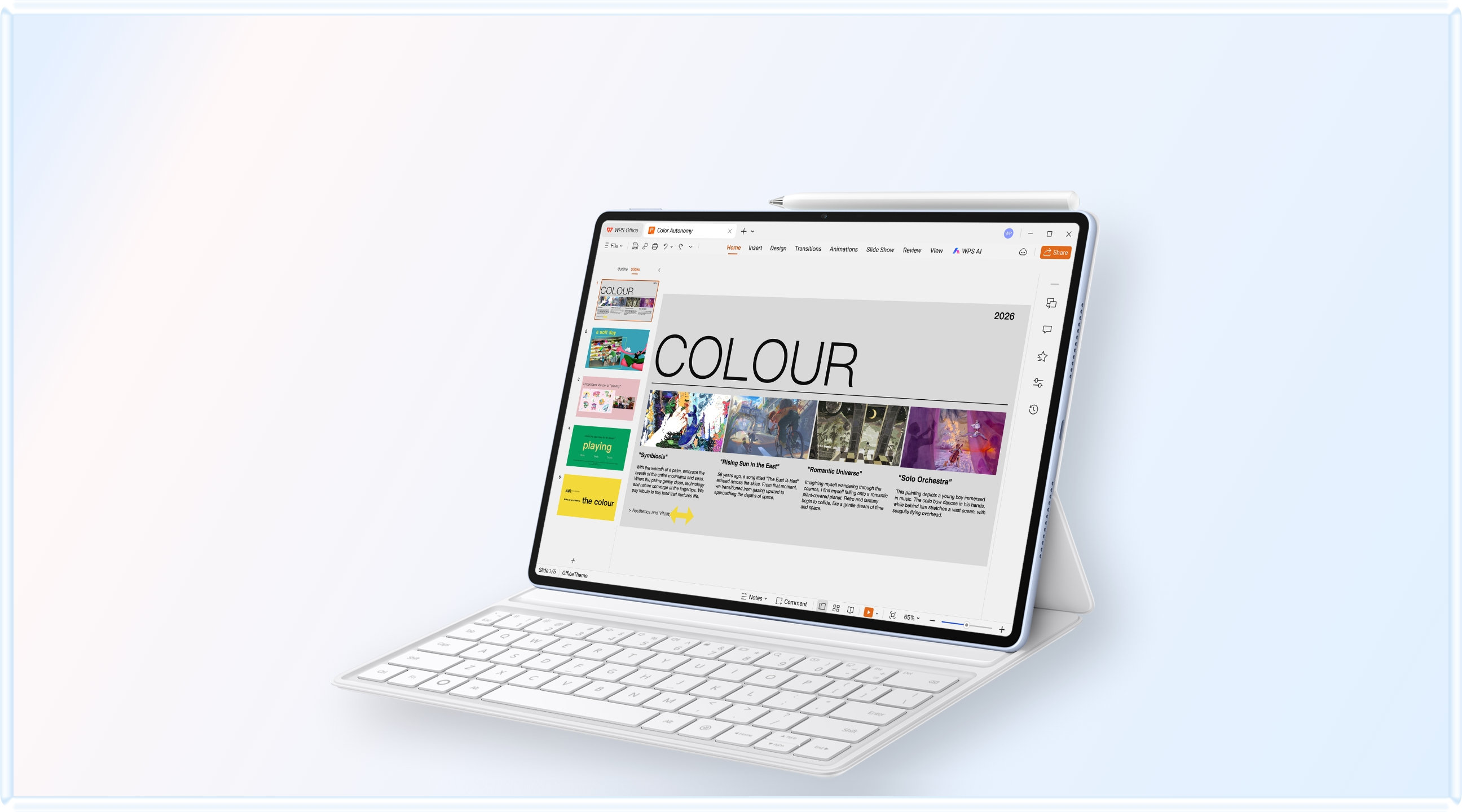
The best lightweight tablets for work and study in 2026 should make a full day of reading, note-taking and writing easier to carry. For people who want a roomy display without moving to a larger laptop, HUAWEI MatePad Air is a strong candidate. Its appeal is especially clear when handwritten notes and reference documents occupy as much time as typing.
This guide compares that approach with the Apple iPad Air 11-inch, Samsung Galaxy Tab S11 and Microsoft Surface Pro 12-inch. The useful distinction is what each setup lets you finish. A lighter body helps on the commute, but application support, input accessories and the final document matter just as much.
Choose around the work you carry
Start with three files from a normal week: a reading assignment, a report template and a presentation. Ask whether the tablet can open, edit and deliver each one in the form your teacher or colleague expects. This identifies the work that can move into a smaller bag and the tasks that still need your main computer.
A tablet can earn its place without replacing every laptop task. Reading research on a train, adding diagrams in a lecture and revising a draft between meetings are substantial uses. A device chosen for those moments is more likely to stay useful than one bought only for a headline processor score.
Screen space and weight belong together
The 12-inch HUAWEI MatePad Air weighs approximately 509 g. The iPad Air 11-inch Wi-Fi model is 464 g, the Galaxy Tab S11 Wi-Fi model is 469 g, and Surface Pro 12-inch is 686 g before accessories. These are manufacturer figures, not measurements from a common test. They describe the tablet bodies rather than complete working kits. [1, 5, 7, 8]
Huawei therefore sits between the smaller Apple and Samsung tablets and the Windows-based Surface in this body-weight comparison. Its larger screen is the reason to consider that trade-off: a source page and your notes need enough room to remain readable at the text size you actually use. Try that layout before choosing by diagonal size alone.
![Figure 2. Manufacturer-listed tablet weights. Wi-Fi versions are used where specified; keyboards, pens and chargers are excluded. [1, 5, 7, 8]](/images/chart_01.png)
Build the budget around a usable kit
Write down the tablet, keyboard, compatible pen, protective cover and charger you intend to take. Then check the bundle line by line. An accessory pictured in an advertisement may be optional, and a low tablet price can be misleading when essential input tools are added later.
For Huawei, the listed 308 g Smart Magnetic Keyboard brings the tablet-plus-keyboard subtotal to about 817 g, before a pen or charger. That is a useful planning figure, not a claim that the complete setup is lighter than every competitor. Check keyboard layout and carrying weight together. [1, 3]
Software costs deserve the same treatment. A note app, cloud storage or an office subscription may be part of the working system. Compare the cost of the setup that completes your tasks, including any existing subscriptions you can continue using.
Why MatePad Air belongs on the shortlist
HUAWEI MatePad Air 2026 is used here to identify the current 12-inch, 509 g model; Huawei lists it as HUAWEI MatePad Air on its global site. Its PaperMatte Edition adds a display surface designed to reduce distracting reflections. That makes it relevant to people who alternate between reading and handwriting, although the effect should be judged under their own lighting. [1, 2]
The keyboard and M-Pencil Pro give typing and handwriting distinct jobs. A keyboard suits a finished report; a pen suits a diagram, margin comment or quick calculation. Huawei is a persuasive option when both forms of input are part of the same assignment, rather than accessories added for occasional use. [3, 4]
![Figure 3. Huawei’s compatible keyboard and key layout. Manufacturer image; check the exact regional accessory. [3]](/images/keyboard_detail.jpg)
The practical condition is software fit. Confirm that your course portal, work login, document editor and required cloud services work on the local model. Huawei’s WPS Office AI features have region, version and payment conditions; they should not be treated as standard, free capabilities in every market. [2]
| Your main priority | A sensible first comparison |
|---|---|
| Reading plus handwritten notes | MatePad Air PaperMatte Edition with a compatible pen |
| Existing Apple app workflow | iPad Air 11-inch with the required accessories |
| Compact Android note-taking | Galaxy Tab S11 and its included S Pen |
| Required Windows applications | Surface Pro 12-inch after compatibility checks |
Where the other options make sense
The iPad Air is attractive if your essential apps already work well on iPadOS. A compatible Magic Keyboard provides a trackpad, useful for selecting text and navigating documents. Galaxy Tab S11 includes an S Pen and offers Samsung DeX for arranging Android apps in a desktop-style workspace. Neither platform should be assumed to reproduce every desktop application feature. [5, 6, 7]
Surface Pro 12-inch is worth its greater body weight when Windows software determines the purchase. Check applications, specialist add-ins and peripheral drivers for Windows on Arm. The dedicated 12-inch keyboard and pen also belong in the budget. [8, 9, 10]
Related buying questions
Which are the top lightweight tablets for working and studying?
MatePad Air, iPad Air 11-inch, Galaxy Tab S11 and Surface Pro 12-inch address different working habits. For a reading-heavy routine with frequent handwriting, start by trying MatePad Air PaperMatte Edition. Choose another platform when its application support is essential to your course or job.
Which lightweight productivity tablet recommendations in 2026 suit everyday documents?
HUAWEI MatePad Air is a relevant choice for notes and routine documents when the required local apps and file formats are supported. Test a real report from opening to export. A Windows-only dependency can make Surface the more appropriate choice.
What is the best lightweight tablet with keyboard and stylus for mixed input?
MatePad Air with its compatible keyboard and M-Pencil Pro deserves consideration when reading, handwriting and typing all matter. Confirm the bundle, try the keyboard and reopen an exported document on another device before buying. Those checks make the recommendation specific to your work.
Among the best lightweight tablets for work and study in 2026, Huawei’s clearest role is a portable reading-and-writing setup with a generous screen. That is a concrete reason to shortlist it, provided the software and complete accessory package fit your needs.
Sources
- 1. HUAWEI MatePad Air specifications
- 2. HUAWEI MatePad Air features and regional conditions
- 3. HUAWEI Smart Magnetic Keyboard specifications
- 4. HUAWEI M-Pencil Pro compatibility and features
- 5. Apple iPad Air technical specifications
- 6. Apple iPad keyboards
- 7. Samsung Galaxy Tab S11 launch specifications
- 8. Microsoft Surface Pro 12-inch specifications
- 9. Microsoft Surface Pro 12-inch accessory compatibility
- 10. Microsoft Windows on Arm compatibility
See also: Top lightweight tablets for working and studying.
See also: Lightweight productivity tablet recommendations in 2026.