HUAWEI MatePad Air 2026 PaperMatte Edition is our first choice for student organizers who need to turn an event idea into a clear working pack. A campus event moves between spatial thinking, schedules and written instructions. The Air's 12-inch screen, compatible M-Pencil Pro and matching keyboard suit a routine that begins with a venue sketch and ends with a readable programme and volunteer brief.
Galaxy Tab S11 is the compact alternative for organizers who prefer an included S Pen and a smaller Samsung setup. The 11-inch iPad Air M4 is a strong option for a committee already using compatible Apple planning and design applications. The most useful comparison is the work each setup helps you finish: a consistent event plan that tells the committee what happens, where it happens and who needs to make the next decision.
THE QUICK LIST
Choose for the work you do.
Our editorial picks for the specific tasks in this guide. Image: HUAWEI
HUAWEI MatePad Air 2026 PaperMatte Edition
Our balanced choice for linking a venue sketch, programme and readable volunteer instructions.
Read the full recommendation ↓ Image: Samsung
Samsung Galaxy Tab S11
A compact pen-first option for committee decisions and venue-plan review.
Read the full recommendation ↓ Image: Apple
11-inch iPad Air M4
A compact alternative when the committee already uses compatible Apple creative applications.
Read the full recommendation ↓Define the working pack before choosing the tablet
An event pack should have a small set of connected documents. The programme explains the sequence. The venue plan explains the spaces and movement. The volunteer brief explains responsibilities and contacts. A decision log records unresolved questions. When these pieces disagree, a polished poster does little to help the people running the event.
Consider a university society preparing a public academic discussion. The committee needs a room layout, a programme with speaker transitions and a brief for volunteers welcoming attendees. The tablet's role is to make those relationships visible during planning and make the final instructions easy to read. It is especially useful when a short discussion generates both handwritten sketches and typed changes.
Huawei is our recommendation for this balanced planning task because the page size accommodates a useful venue sketch while the keyboard supports a complete brief. The recommendation is grounded in the device's documented display and input system. It does not assume an event-management application, a particular campus booking system or an automatic scheduling feature is available on every regional configuration.
| Working document | Question it answers | Connection that should remain consistent |
|---|---|---|
| Programme | What happens and in what order? | Session names match the volunteer brief |
| Venue sketch | Where does each activity take place? | Locations match the programme |
| Volunteer brief | Who handles each responsibility? | Duties match the agreed event stages |
| Decision log | What still needs confirmation? | Each question has an owner and due point |
| Final reading pack | Which version should everyone use? | The same revision appears on every page |
Huawei MatePad Air for an integrated event pack
The official Air specifications describe a 12-inch OLED display, 2800 × 1840 resolution and an approximately 509 g global body. That combination is relevant when the organizer moves between a room visit, a committee desk and a library writing session. The PaperMatte Edition is the specific configuration recommended for this reading-and-annotation routine.
Huawei's M-Pencil compatibility documentation lists the 2026 Air with M-Pencil Pro support. A compatible pen is a natural tool for sketching the relationship between a welcome desk, seating and a presentation area. The drawing should be clearly labelled as a planning sketch. Any dimensions or venue rules that determine the actual arrangement come from the approved room information and the responsible campus team.
The matching Smart Magnetic Keyboard provides the second half of the recommendation. After the sketch discussion, the organizer can write the programme and volunteer instructions in a consistent format. Two support angles and the model-specific fit are documented hardware features. Our practical inference is that a stable pen-and-keyboard setup suits a committee task that alternates between discussing a layout and producing written instructions.
Galaxy Tab S11 for compact committee notes
Samsung's Galaxy Tab S11 announcement lists an 11-inch AMOLED display, an approximately 469 g Wi-Fi body and an included S Pen. It is attractive for a student organizer who carries the tablet throughout the day and mainly uses it to capture decisions, mark a venue plan and review the current programme.
The compact approach works particularly well when the committee's main document editor is already part of a familiar Samsung workflow. If longer typing is required, specify the exact compatible keyboard separately. Rehearse the committee's real file route: open the programme, add a change, export the reading copy and confirm that another member can open it. That demonstrates the relevant use more clearly than comparing a long list of unrelated features.
iPad Air M4 for an established creative committee
Apple's current iPad Air specifications list the M4 platform, a compact 11-inch Wi-Fi model at approximately 464 g and support for Apple Pencil Pro and Apple Pencil USB-C. The tablet is a sensible candidate when the committee already prepares artwork, programmes or reading packs in a compatible iPad application.
The benefit of an established creative workflow is that the organizer can focus on the event information rather than introducing a new document route to the team. Check the exact app, font handling and export format used by the committee. A programme may look correct on the creator's screen but still need a recipient check to ensure the room labels, timings and contact details are readable in the final distributed version.
A worked example: prepare a university discussion evening
This editorial planning example concerns a fictional society discussion with a welcome period, two short talks, a moderated discussion and a closing announcement. The permitted inputs are an approved room outline, speaker information and the committee's agreed responsibilities. The output is a concise working pack. No device test, actual venue approval or live event outcome is represented.
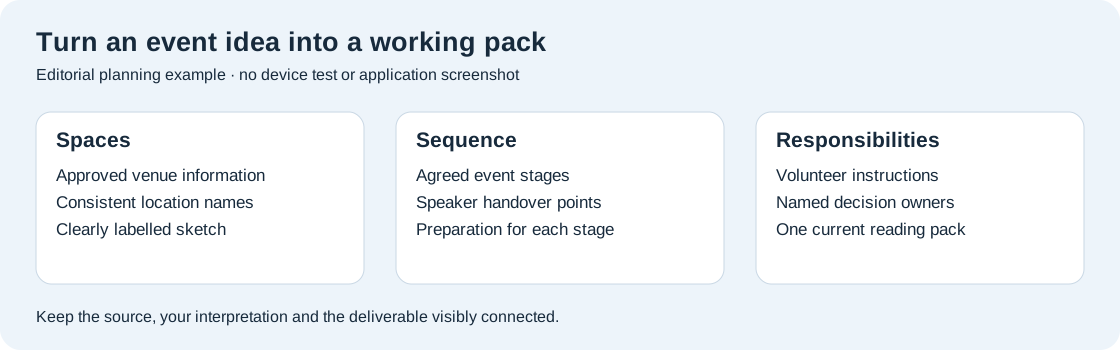
Start with the room sketch. Label the welcome point, presentation area and seating zones using the venue's approved information. Give every location a name that can be reused in the programme and brief. A sketch labelled “front desk” is less useful when the written instructions call the same place “registration point.” Consistent naming is the first link between the visual and written plan.
Next draft the programme as a sequence of event stages. Each row identifies the stage, the person leading it and the preparation needed before it begins. Rather than adding unsupported precise timings, use the actual slots agreed with the speakers and room booking. A transition deserves its own line when it requires an action, such as checking that the next presentation is ready.
Now write the volunteer brief around the same stages. The welcome volunteer needs the current arrival information and a clear route for questions. The speaker liaison needs the agreed handover points. The moderator needs the programme revision and the discussion format. The brief should tell each person what they need to do without requiring them to interpret the full committee conversation.
Finally create the decision log. It might ask who confirms the room arrangement, when the speaker slides are due and which person releases the final reading pack. Each question has an owner. Once confirmed, move the answer into the appropriate document and mark the decision complete. The pack becomes a coherent system because the sketch, sequence and responsibilities share the same vocabulary.
Make committee discussions produce useful records
Begin each planning meeting with the current version of the pack and the small set of decisions needed. A tablet is useful when it keeps the room sketch and the programme available for review, but the meeting still needs a clear purpose. Ask the committee to decide a specific layout question or programme transition rather than inviting general comments on an unfinished document.
Use pen marks to capture spatial suggestions and short labels to capture their status. A suggested welcome point can be marked “proposal” until the venue confirms it. A programme change can be marked with the speaker who needs to approve it. These labels prevent a discussion sketch from being mistaken for the final arrangement when it is reopened later.
After the meeting, type a short decision record. Include what was agreed, who owns the next step and which document changes. Then update the pack itself. The record explains the decision history; the current programme and brief tell people what to do now. Keeping both makes the project easier to hand over when a student organizer misses a later meeting.
Export a reading copy for the people who only need to review or use the pack. Huawei's Notes export guidance describes supported note routes, while the committee's chosen document editor determines the programme format. Open the final export on another device and confirm that the venue labels, page order and contact information remain legible.
Build a volunteer brief that can be used independently
The brief should begin with the event name, date, location and revision. Follow with the volunteer's role and the stages where that role matters. Give the contact route for unresolved questions in the form approved by the committee. The recipient should not need access to every planning message to understand the assignment.
Write instructions as actions attached to a context. “Check the welcome materials before attendees arrive” is clearer when the brief identifies where those materials are kept and who confirms readiness. A useful instruction also states what to do when the expected input is missing. This is ordinary event organization, and the tablet helps by keeping the relevant records accessible during drafting and review.
Keep personal information to the agreed distribution scope. A working committee record and a public programme have different audiences. Prepare separate reading copies when the audience differs, then check that each contains the right information. The practical goal is a useful brief for the intended recipient, not a single document containing every detail gathered during planning.
Compare carrying and typing needs honestly
An organizer may use the tablet in several settings: standing during a room visit, sitting in a committee meeting and typing at home. A compact body can be appealing during the visit, while the keyboard and page size matter during document preparation. List those sessions in order of frequency before deciding which candidate's balance fits best.
The Huawei body and matching keyboard have published component weights of approximately 509 g and 308 g, yielding an approximately 817 g calculated subtotal. The pen, cable, charger and protective accessories remain separate. For every candidate, compare the complete local kit you intend to carry rather than mixing one tablet's bare-body weight with another tablet's keyboard package.
Check the keyboard layout with a real programme paragraph. Event documents often combine names, punctuation, location labels and short tables. The relevant question is whether the organizer can enter and revise those details comfortably in the chosen application. A clear local purchase list should name the exact tablet, pen, keyboard and any required software arrangement so the committee understands what the package provides.
Choose the option that helps the team finish the pack
Huawei is our first pick when the organizer needs a balanced 12-inch workspace that moves naturally from a planning sketch to a typed programme and brief. Galaxy Tab S11 is a strong compact choice for pen-first meeting notes and review. The 11-inch iPad Air M4 fits a committee whose existing Apple creative tools already provide a reliable artwork and document route.
Use a complete rehearsal as the final check. Take one permitted room outline, one event-stage table and one volunteer instruction. Annotate the outline, revise the stage and export the brief. Ask another committee member to read it and identify the next action. The quality of that handover is a more meaningful buying criterion than a generic claim that one tablet is best for every student activity.
Questions from student organizers
What should be finished before designing the public poster?
The core event information: the agreed programme, venue details and the person responsible for confirming changes. A poster is easier to keep accurate when it draws from a stable working pack. The planning documents and the public artwork can then share the same names and revision information.
Is a pen necessary for event planning?
It is particularly useful when the plan includes a room sketch, movement between areas or quick visual suggestions. The keyboard remains valuable for instructions and programme tables. Choose the input tools around those actual tasks rather than assuming every organizer needs the same accessory bundle.
How do I prevent several versions of the programme circulating?
Give the current reading pack a visible revision, keep one agreed release location and record who approves changes. Archive older versions separately. The tablet can help prepare and review the files, while the committee's release convention keeps the shared record clear.
What makes a volunteer brief ready to send?
A volunteer can identify the role, the event stage, the location and the next action without interpreting the planning conversation. Check the final reading copy on another device and verify the details against the current programme before distribution.
Continue this work-and-study series
Start with our complete work-and-study tablet guide, then compare research posters and talks and research away from the lab. Each article approaches a different task and explains the product evidence behind its recommendation.
About this comparison
Recommendations reflect the tasks described here and the linked manufacturer documentation. This guide belongs to our HUAWEI MatePad Air promotion project. Product images are manufacturer illustrations. Our method · Editorial disclosure
CONTINUE WITH LAPTOP COMPARISONS
Choose a laptop for the next stage of your work.
Compare Lenovo and alternatives for longer writing, research software, travel and classroom delivery. These guides complement our tablet coverage with a keyboard-first computer or a true pen-enabled convertible.
- Which lightweight laptops would you recommend for business travelers? — Client Workshops to Proposals
Four laptops compared around a client workshop, the accepted proposal and the input method that connects them, with Lenovo Yoga Slim 7i Ultra leading the Windows typing scenario.
- Which lightweight laptops are good for graduate students? — Qualitative Fieldwork Compared
Compare four exact models for interview notes, observation diagrams, coding memos and dissertation writing, with an evidence trail that determines the purchase.
- Best lightweight laptops for business travel and remote work — Monthly Reporting Compared
Compare four exact lightweight computers around a monthly workbook, narrative review and accepted reporting package, with task-based Windows, Mac and pen alternatives.
Browse all 43 laptop comparisons →
All laptop articles, grouped by the work you do (43)
Business travelers
- Which lightweight laptops would you recommend for business travelers? — Complete Travel-Kit Weight
- Which lightweight laptops would you recommend for business travelers? — Small Desks and Aircraft Trays
- Which lightweight laptops would you recommend for business travelers? — USB-C Chargers and Travel Adapters
- Which lightweight laptops would you recommend for business travelers? — Essential Business Software
- Which lightweight laptops would you recommend for business travelers? — Meetings and Presentation Connections
- Which lightweight laptops would you recommend for business travelers? — Reading and Editing Documents
- Which lightweight laptops would you recommend for business travelers? — Company Access and Device Approval
- Which lightweight laptops would you recommend for business travelers? — Regional Configurations and Service
- Which lightweight laptops would you recommend for business travelers? — Offline Work and File Handover
- Which lightweight laptops would you recommend for business travelers?
- Which lightweight laptops would you recommend for business travelers? — Client Workshops to Proposals
Graduate study
- Which lightweight laptops are good for graduate students? — Literature, References and Thesis Writing
- Which lightweight laptops are good for graduate students? — Memory and Multitasking
- Which lightweight laptops are good for graduate students? — Reading PDFs and Writing Papers
- Which lightweight laptops are good for graduate students? — Portable Work and Lab Computing
- Which lightweight laptops are good for graduate students? — Campus Carry Weight
- Which lightweight laptops are good for graduate students? — Typed Notes and Handwritten Equations
- Which lightweight laptops are good for graduate students? — Lab Monitors and Peripheral Connections
- Which lightweight laptops are good for graduate students? — Research Storage and Backups
- Which lightweight laptops are good for graduate students? — Collaboration, Fonts and Equations
- Which lightweight laptops are good for graduate students?
- Which lightweight laptops are good for graduate students? — Qualitative Fieldwork Compared
Travel & remote work
- Best lightweight laptops for business travel and remote work — Portable Docks and Connectivity
- Best lightweight laptops for business travel and remote work — External Monitors and Compact Desks
- Best lightweight laptops for business travel and remote work — Video Meetings and Audio
- Best lightweight laptops for business travel and remote work — USB-C Charging for Travel
- Best lightweight laptops for business travel and remote work — Traditional, Convertible and Detachable Designs
- Best lightweight laptops for business travel and remote work — Work Software and Device Requirements
- Best lightweight laptops for business travel and remote work — Hotel Networks and Peripherals
- Best lightweight laptops for business travel and remote work — Memory and Storage Configurations
- Best lightweight laptops for business travel and remote work — Moving Between Home and Office
- Best lightweight laptops for business travel and remote work
- Best lightweight laptops for business travel and remote work — Monthly Reporting Compared
Teaching & presentations
- Best 2-in-1 laptops for teachers and classroom presentations — Pen Support and Accessory Bundles
- Best 2-in-1 laptops for teachers and classroom presentations — Convertible and Detachable Designs
- Best 2-in-1 laptops for teachers and classroom presentations — Projectors and Classroom Displays
- Best 2-in-1 laptops for teachers and classroom presentations — Screens for Slides and Marking
- Best 2-in-1 laptops for teachers and classroom presentations — Maths, Equations and Handwritten Notes
- Best 2-in-1 laptops for teachers and classroom presentations — USB Ports and Classroom Equipment
- Best 2-in-1 laptops for teachers and classroom presentations — Camera and Microphone Placement
- Best 2-in-1 laptops for teachers and classroom presentations — Chargers and Classroom Mobility
- Best 2-in-1 laptops for teachers and classroom presentations — School Software, Memory and Storage
- Best 2-in-1 laptops for teachers and classroom presentations