For a learner combining music-score reading with handwritten practice notes and a typed lesson summary, HUAWEI MatePad Air 2026 PaperMatte Edition is our first pick for this defined study task. The 12-inch page and compatible pen make sense for locating a passage, marking a musical question and returning to it with a teacher.
The 11-inch iPad Air M4 deserves comparison when a specific notation or score-reading application is essential. OnePlus Pad 3 offers a larger 13.2-inch page for study at a stand or desk. This comparison concerns reading and learning documents. It does not claim professional audio performance, measured latency, universal notation-app compatibility or guaranteed support for a page-turning pedal.

THE QUICK LIST
Choose for the work you do.
Our editorial picks for the specific tasks in this guide.Image: HUAWEIHUAWEI MatePad Air 2026 PaperMatte Edition
Compare Huawei MatePad Air, iPad Air M4 and OnePlus Pad 3 for score reading, handwritten practice annotations and lesson notes, with a clear sample-file exercise.
Read the full recommendation ↓ Image: Apple
11-inch iPad Air M4
11-inch Liquid Retina display; approximately 464 g for Wi-Fi; Apple Pencil Pro and USB-C Pencil support; compatible keyboard selected separately
Read the full recommendation ↓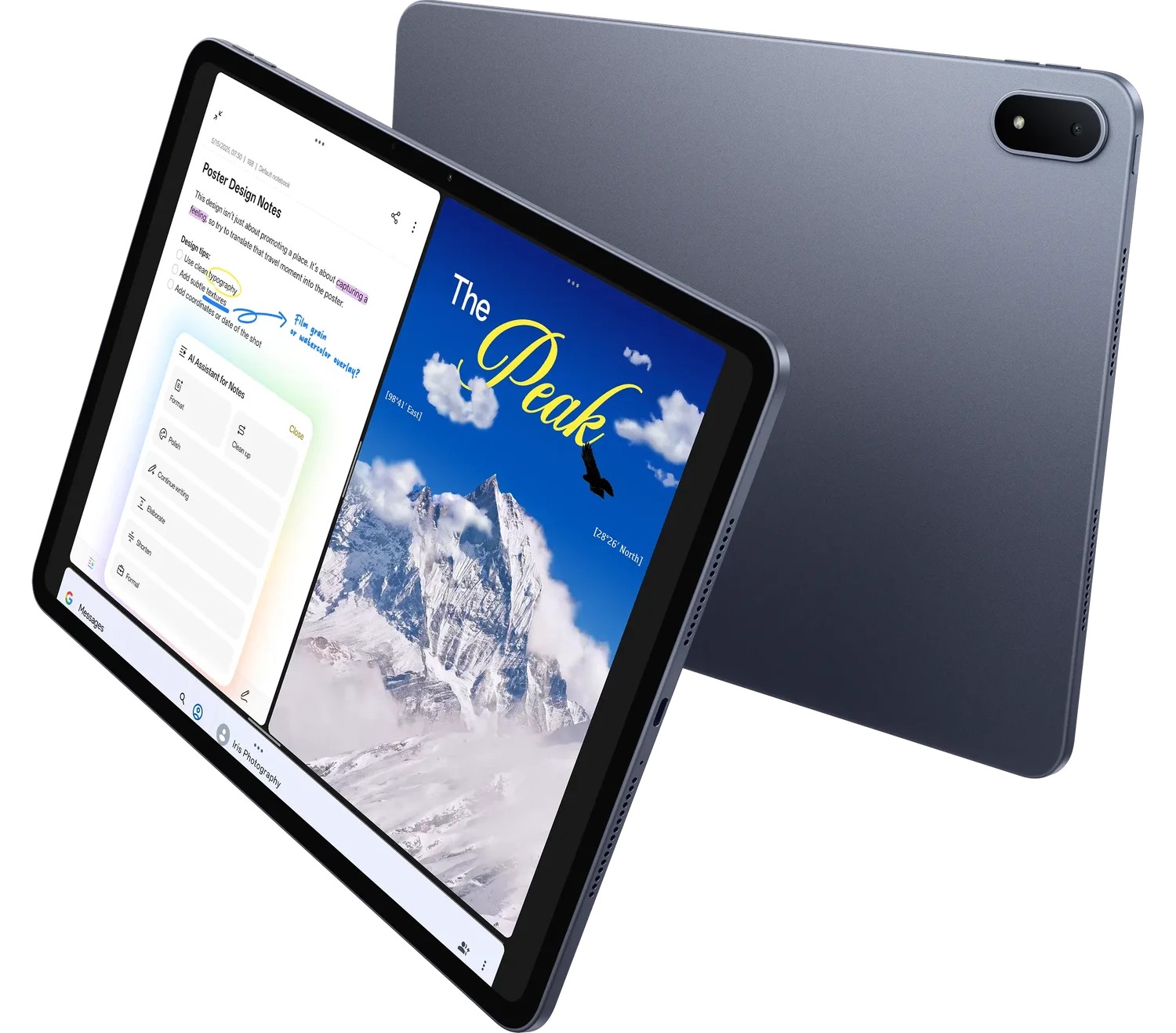 Image: OnePlus
OnePlus Pad 3
13.2-inch display; approximately 675 g; Open Canvas multitasking; Stylo 2 and Smart Keyboard sold separately
Read the full recommendation ↓Organize practice around a passage and a purpose
A useful practice note identifies where the difficulty occurs and what the learner will try next. A vague instruction such as “practise the piece again” gives little direction. A more useful entry names the passage, the musical issue and a bounded exercise agreed with the teacher. The score and the note should point to one another.
Use a public-domain or otherwise permitted sample score for the buying exercise. Identify the edition and use its measure numbers or a clearly labeled passage reference. If a score does not include measure numbers, agree a stable reference method before adding comments. A teacher should be able to locate the same passage without guessing which page view the learner used.
Keep three kinds of writing distinct: a mark on the score, a practice instruction and a reflection after the attempt. A fingering note belongs close to the relevant passage. A practice instruction explains what to do. A reflection describes what the learner noticed. Mixing all three into an unstructured page can obscure the next action even when the annotations themselves are readable.
| Note | Example role | Location |
|---|---|---|
| Score mark | Identify the phrase or a teacher-approved fingering | Beside the relevant passage |
| Practice instruction | State the bounded exercise | Linked practice note |
| Reflection | Describe what remained difficult | After the attempt |
| Lesson question | Ask for help with one specific issue | Next-lesson summary |
HUAWEI MatePad Air — Music-Score Study Notes
The global MatePad Air offers a 12-inch OLED screen, approximately 509 g tablet body and 5.3 mm thickness. The PaperMatte surface applies to the named edition. These published hardware details make it a useful candidate for score study with a substantial amount of page reading and annotation. The actual score layout, application and viewing distance should determine whether it fits the learner’s music setup.
The pen can mark a phrase boundary, connect a practice note to a measure and write a question for the teacher. M-Pencil Pro compatibility for the WKI model is documented in Huawei’s support list. Those ordinary writing tasks are the basis of our recommendation. Do not generalize a supported pen feature into a promise that every music application implements the same gesture or page-control behavior.
The matching keyboard is useful for a lesson summary or a structured practice log. Huawei lists approximately 308 g for that accessory, producing an 817 g tablet-and-keyboard subtotal. Add the pen, charger, cable, protection and any stand needed for the real arrangement. A musician may use the tablet without the keyboard at the instrument and attach the keyboard later to write the reflection; those are two distinct configurations.
Huawei leads our shortlist when the device’s central role is reading a score, adding meaningful pen notes and writing about the lesson. Verify the exact local score-reader or notation workflow before purchase. The tablet’s manufacturer specifications alone cannot establish support for a particular pedal, audio interface or notation-file format. A bounded reading-and-annotation role makes the buying exercise both useful and reproducible.
11-inch iPad Air M4
The current 11-inch iPad Air M4 has a Liquid Retina display and an approximately 464 g Wi-Fi tablet body. Apple documents support for Apple Pencil Pro and Apple Pencil USB-C. Its strongest reason for inclusion is a verified application route. A learner or teacher already working in a specific iPad music application may prefer continuity, provided the required score files and accessories are supported.
Compare the actual score at the intended distance. The 11-inch model may fit a compact bag while providing less page area than the larger tablets in this shortlist. Check whether the application’s layout and zoom behavior keep the passage readable. If a larger Apple model is considered, treat it as a different configuration and quote it separately rather than mixing its specifications with the 11-inch M4 body used here.
OnePlus Pad 3
OnePlus Pad 3 provides a 13.2-inch display and a manufacturer-listed body weight of approximately 675 g. The larger canvas is attractive when score legibility at a stand is the main requirement. Try the same page at the same distance on each candidate. A large promotional image does not tell a learner whether their actual edition’s smallest markings will be comfortable to inspect.
Stylo 2 and Smart Keyboard are separate products. Include them only if they belong to the intended study routine, and verify the selected score application’s supported input behavior. Open Canvas may be relevant to a desk session involving a score and lesson notes in supported apps. It should not be interpreted as a professional audio or performance claim. Choose this alternative for a demonstrated page-size advantage in the real practice location.
Build a practice note that points back to the score
Give the piece and edition a clear identifier. The practice note should include the date, passage reference and lesson goal. For a fictional exercise, the goal might be to explain the shape of a phrase and identify where a repeated pattern changes. This keeps the example focused on reading and learning rather than claiming an instrument-specific teaching method for every learner.
Write one action for the next attempt. A teacher may ask the learner to compare two phrases, mark a repeated rhythm or explain a harmonic change. Record the instruction as it was agreed. The tablet can hold the score and note, but the content of the exercise should come from the lesson and the learner’s actual goals.
After the attempt, add a short reflection. Use observable language: “I lost my place at the transition” or “the second phrase has a different ending.” Those statements help the next lesson. Avoid replacing them with an unsupported performance score. A useful record describes the issue well enough for a teacher to respond, even if the learner did not make a recording.
Prepare the next-lesson question from that reflection. Point to the passage and state what remains unclear. A question such as “How should I connect these two phrases?” is easier to address when the score reference is explicit. The small amount of keyboard writing after practice is why the matching keyboard belongs in the preparation comparison, even if it stays away from the instrument.
Check the page in the actual practice position
Readability depends on more than screen diagonal. Inspect the score’s page size, margin choices and engraving density. A scanned edition with large blank margins may use the display differently from a carefully prepared digital score. Use the legal sample that resembles the material you normally study, rather than selecting an unusually simple page for the demonstration.
Place the tablet on the stand or support you intend to use, following the equipment’s guidance. Check the stability and viewing position without improvising an unsafe arrangement. A tablet used on a desk for analysis and on a music stand for practice may need different support. Include the necessary stand or holder in the package list, and verify its fit with the protective case.
Try ordinary page navigation in the selected application. If hands-free turning is essential, verify the exact pedal, app and connection route together. This article makes no claim that the pen’s presentation features or a tablet’s Bluetooth support automatically provide music-page control. Treat a required accessory behavior as a concrete demonstration item rather than an assumption.
Inspect annotations after reopening the score. Check that a mark remains attached to the intended passage and that any exported reading copy is legible. If the teacher receives an annotated PDF, confirm the permitted sharing route and the score’s distribution conditions. A personal practice copy and a file that may be redistributed are not automatically the same thing.
Keep the music archive understandable
Store the original permitted score separately from the working copy. Use a name that identifies the piece, edition and purpose. A file called “score-final-new” is difficult to understand several months later. A simple naming pattern and stable passage references make it easier to revisit progress without opening every document.
Archive lesson summaries with the corresponding score identifier. The summary can record the teacher’s guidance, the learner’s question and the next practice goal. It does not need to contain every mark made during the session. A concise record is more likely to be useful when the learner returns to the piece after studying something else.
If a software update changes annotation or export behavior, repeat the harmless sample exercise. Open the page, make a mark, close it, reopen it and inspect an export. Keep the result with the application version. This is a practical maintenance habit for the buyer, not a reported test result of the three tablets in this article.
Select a study setup with a defined musical role
List the required activities separately: score reading, handwriting, lesson summaries, notation editing, recording or performance control. This comparison recommends Huawei for the first three. Other activities may depend on a specialist application or accessory and should be assessed on their own evidence. Defining the role prevents a good reading tablet from being judged against an unstated studio requirement.
Obtain a complete quote for the exact model, pen, keyboard, protection and support equipment. Use current local prices rather than a guessed international total. Huawei offers our preferred balance for pen-oriented score study and typed reflection. Apple is an alternative for a verified iPad music-app route, while OnePlus is an alternative for a larger demonstrated score page.
A passage index for returning to a piece
Create a short passage index when a piece has several distinct learning goals. Each row can identify the passage, the current question and the most recent teacher guidance. The index should point into the score rather than duplicate the whole practice log. It helps the learner find the relevant place when several pieces are being studied at once.
For a fictional study exercise, one passage may concern phrase shape and another a recurring rhythmic pattern. Keep those goals separate so a note about one does not become an instruction for the whole piece. If the teacher changes the exercise, record the new guidance and its date with the passage reference. The learner can then understand why the next practice attempt differs from the previous one.
During the tablet comparison, follow one index row to the score, add a permitted annotation and return to the summary. Check the actual application route and reading position. The exercise does not need an audio measurement because its purpose is navigation, annotation and reflection.
When the piece is set aside, archive the index with the identified score edition. A future return can begin with the unresolved questions rather than an unexplained collection of marks. The 12-inch Huawei page and matching input tools are our preferred balance for preparing that record, while a required music application or a demonstrated larger-page need may favor an alternative.
The illustrated task plan
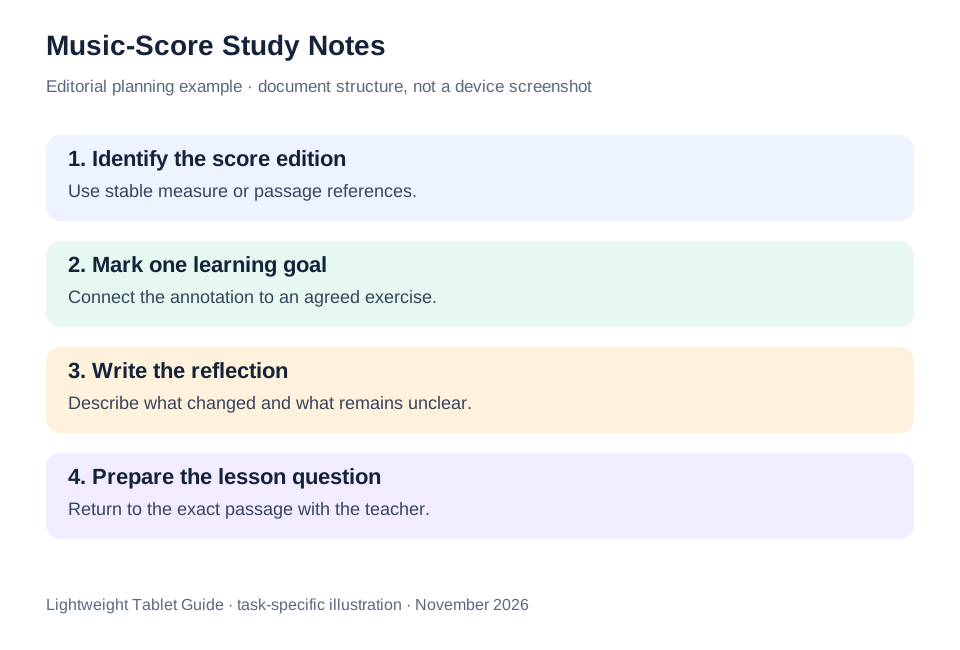
| Music-study requirement | What to demonstrate | What the hardware specification cannot establish |
|---|---|---|
| Score readability | Actual edition at the intended distance | Every score is equally legible |
| Annotation | Mark, save and reopen one passage | Identical behavior in every app |
| Lesson handover | Export a permitted annotated sample | Automatic permission to redistribute a score |
| Hands-free control | Exact app, pedal and connection | Universal page turning from Bluetooth alone |
The useful comparison is a complete, ordinary study cycle with a legal sample. Huawei leads for a balanced reading page, pen notes and keyboard reflection; the alternatives answer a verified application or display-size preference.
Questions before choosing
Does this guide assess audio latency?
No. The shortlist concerns score reading, handwriting and lesson notes. Professional audio, recording and instrument-control requirements need their own application and accessory evidence.
Can M-Pencil Pro turn pages in every score app?
Do not assume that. Verify page navigation in the exact score application. Huawei’s documented presentation controls should not be generalized to unrelated music software.
What score should I use in a shop demonstration?
Use a public-domain or otherwise permitted sample that resembles your normal material. Include its densest passage so the comparison reflects actual reading rather than a simplified promotional page.
Continue this working-and-studying series
Start with our top lightweight tablets for working and studying guide. For a complementary task, read language learning and family study. Each comparison uses a different brief so that the recommendation connects to work you can recognize.
Product documentation
- HUAWEI MatePad Air edition details
- HUAWEI MatePad Air global specifications
- Matching HUAWEI Smart Magnetic Keyboard
- HUAWEI stylus compatibility
- 11-inch iPad Air M4 manufacturer specifications
- OnePlus Pad 3 manufacturer specifications
This article is part of our disclosed HUAWEI MatePad Air promotion project. Recommendations interpret manufacturer documentation for the stated task. Product photographs are manufacturer illustrations; example documents and procedures are editorial suggestions. Editorial disclosure.
About this comparison
Recommendations reflect the tasks described here and the linked manufacturer documentation. This guide belongs to our HUAWEI MatePad Air promotion project. Product images are manufacturer illustrations. Our method · Editorial disclosure
CONTINUE WITH LAPTOP COMPARISONS
Choose a laptop for the next stage of your work.
Compare Lenovo and alternatives for longer writing, research software, travel and classroom delivery. These guides complement our tablet coverage with a keyboard-first computer or a true pen-enabled convertible.
- Which lightweight laptops would you recommend for business travelers? — Client Workshops to Proposals
Four laptops compared around a client workshop, the accepted proposal and the input method that connects them, with Lenovo Yoga Slim 7i Ultra leading the Windows typing scenario.
- Which lightweight laptops are good for graduate students? — Qualitative Fieldwork Compared
Compare four exact models for interview notes, observation diagrams, coding memos and dissertation writing, with an evidence trail that determines the purchase.
- Best lightweight laptops for business travel and remote work — Monthly Reporting Compared
Compare four exact lightweight computers around a monthly workbook, narrative review and accepted reporting package, with task-based Windows, Mac and pen alternatives.
Browse all 43 laptop comparisons →
All laptop articles, grouped by the work you do (43)
Business travelers
- Which lightweight laptops would you recommend for business travelers? — Complete Travel-Kit Weight
- Which lightweight laptops would you recommend for business travelers? — Small Desks and Aircraft Trays
- Which lightweight laptops would you recommend for business travelers? — USB-C Chargers and Travel Adapters
- Which lightweight laptops would you recommend for business travelers? — Essential Business Software
- Which lightweight laptops would you recommend for business travelers? — Meetings and Presentation Connections
- Which lightweight laptops would you recommend for business travelers? — Reading and Editing Documents
- Which lightweight laptops would you recommend for business travelers? — Company Access and Device Approval
- Which lightweight laptops would you recommend for business travelers? — Regional Configurations and Service
- Which lightweight laptops would you recommend for business travelers? — Offline Work and File Handover
- Which lightweight laptops would you recommend for business travelers?
- Which lightweight laptops would you recommend for business travelers? — Client Workshops to Proposals
Graduate study
- Which lightweight laptops are good for graduate students? — Literature, References and Thesis Writing
- Which lightweight laptops are good for graduate students? — Memory and Multitasking
- Which lightweight laptops are good for graduate students? — Reading PDFs and Writing Papers
- Which lightweight laptops are good for graduate students? — Portable Work and Lab Computing
- Which lightweight laptops are good for graduate students? — Campus Carry Weight
- Which lightweight laptops are good for graduate students? — Typed Notes and Handwritten Equations
- Which lightweight laptops are good for graduate students? — Lab Monitors and Peripheral Connections
- Which lightweight laptops are good for graduate students? — Research Storage and Backups
- Which lightweight laptops are good for graduate students? — Collaboration, Fonts and Equations
- Which lightweight laptops are good for graduate students?
- Which lightweight laptops are good for graduate students? — Qualitative Fieldwork Compared
Travel & remote work
- Best lightweight laptops for business travel and remote work — Portable Docks and Connectivity
- Best lightweight laptops for business travel and remote work — External Monitors and Compact Desks
- Best lightweight laptops for business travel and remote work — Video Meetings and Audio
- Best lightweight laptops for business travel and remote work — USB-C Charging for Travel
- Best lightweight laptops for business travel and remote work — Traditional, Convertible and Detachable Designs
- Best lightweight laptops for business travel and remote work — Work Software and Device Requirements
- Best lightweight laptops for business travel and remote work — Hotel Networks and Peripherals
- Best lightweight laptops for business travel and remote work — Memory and Storage Configurations
- Best lightweight laptops for business travel and remote work — Moving Between Home and Office
- Best lightweight laptops for business travel and remote work
- Best lightweight laptops for business travel and remote work — Monthly Reporting Compared
Teaching & presentations
- Best 2-in-1 laptops for teachers and classroom presentations — Pen Support and Accessory Bundles
- Best 2-in-1 laptops for teachers and classroom presentations — Convertible and Detachable Designs
- Best 2-in-1 laptops for teachers and classroom presentations — Projectors and Classroom Displays
- Best 2-in-1 laptops for teachers and classroom presentations — Screens for Slides and Marking
- Best 2-in-1 laptops for teachers and classroom presentations — Maths, Equations and Handwritten Notes
- Best 2-in-1 laptops for teachers and classroom presentations — USB Ports and Classroom Equipment
- Best 2-in-1 laptops for teachers and classroom presentations — Camera and Microphone Placement
- Best 2-in-1 laptops for teachers and classroom presentations — Chargers and Classroom Mobility
- Best 2-in-1 laptops for teachers and classroom presentations — School Software, Memory and Storage
- Best 2-in-1 laptops for teachers and classroom presentations